
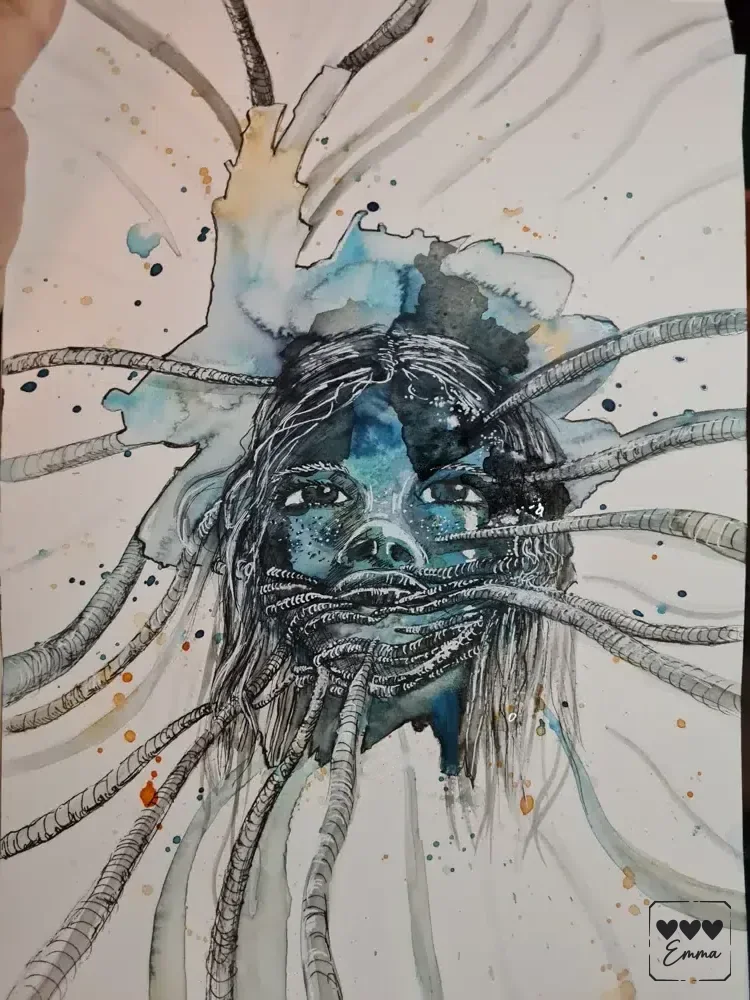
When my first daughter was about a year and a half old, the panic attacks began. I had just moved into a new flat with her. In the evenings, she peacefully turned the pages of her children’s books, and I could relax. She began falling asleep on her own in her bed, and I could settle down comfortably and then go to sleep too.
That would have been lovely, but it was the beginning of my night-time panic attacks, which continue to this day. It has now been twelve years.
It began with me jolting awake just as I was drifting off, with severe breathlessness and pauses in my breathing, whenever I settled down, lay in bed and wanted to fall asleep peacefully. I clutched my chest and throat, ran to the open window and feared for my life because I was about to suffocate. At least, that was how it felt.
The evening attacks, which later also woke me from deep sleep in the middle of the night, were a terrible experience. They became more and more frequent, happened regularly in the evenings and were very difficult to endure. I feared for my life and worried about what would happen if, one morning, I lay lifeless in bed and my little daughter, barely two years old, stood beside her dead mother’s bed, completely helpless and distraught.
That thought alone robbed me of even more sleep. Every evening, I was so trapped in the fear of falling asleep and not waking up the next morning that I became afraid of going to bed at all. Even with strong antidepressants and additional sedatives for the evenings, these symptoms continued for more than a year. I saw various doctors, none of whom found anything wrong. My lungs were fine, my heart was fine, and all my vital signs were within the normal range.
By the time I realised – and that took quite a while – that I was having panic attacks, I had already spoken to my family about it many times. They expressed their sincere sympathy for my situation, but nothing more, of course. At least one person knew where to find the cause I was desperately searching for, but all that came of it was a meaningless “Hmm, you need to relax.”
Skipped heartbeats
Over time, the extreme breathlessness disappeared and was more or less seamlessly replaced by the next symptom. Skipped heartbeats. I had pain in my chest and arm, and my entire upper body tensed up. Once again, I feared for my life, every evening, every time I wanted to relax and perhaps could have.
I jolted awake, drenched in sweat and utterly terrified. I was certain my heart had not beaten for several beats. Again, I gasped for air, tried to calm myself, to regulate myself, and reasoned with my mind. My mind could see that these symptoms only came at night, not during the day, which was reassuring in itself. But it felt so painful and threatening that I went to various doctors and specialists again.
The cardiologist also confirmed: everything was perfectly normal. A second cardiologist said the same thing a year later. Apart from minor irregularities and heart rhythm disturbances, which almost everyone has, I have a healthy heart.
So my lungs and heart were fine. That allowed me to accept that these were panic attacks again.
These symptoms continued for about eight years in total. Sometimes daily. Heart symptoms, breathlessness, anxiety of every kind. Always worrying that one day I would expose my children to the trauma of a dead mother.
Each time I was able to tell myself again, “Calm down, it’s ONLY a panic attack,” the attacks became less severe and easier for me to control. I calmed down more quickly and fell asleep sooner. But every time I recognised one form of panic, it changed into the next.
The jerking movements, the screams
Two years ago, I began screaming so loudly while falling asleep and during sleep that I startled myself and woke myself up.
The loud screams were accompanied by forceful movements, which I initially experienced as muscle twitches. I was afraid of neurological damage because, as soon as I lay in bed in the evening, I could no longer control my movements. I jerked so violently that I sometimes worried about hurting my younger daughter, who always sleeps beside me at night.
It took me a long time to recognise this as a panic attack too, because the terror was missing.
Today, at least, I understand this form of losing control and “releasing” something at night in a slightly more nuanced way.
After the first flashbacks a little over a year ago, it took only a few days for me to understand my life story, my symptoms and my many mental and physical illnesses in a different context.
The breathlessness, the skipped heartbeats, the jerking movements, the screams.
Some of this can certainly be classified as a classic panic attack. The sounds and movements that I still experience every evening and cannot control are now also familiar to me from my EMDR sessions, so I tend to classify them as trauma responses. Bodily memories, coupled with fight-and-flight reflexes that my body could not act on at the time of the events in my childhood.
Since learning these details in therapy – how the brain, nervous system and body work together – some answers have emerged quite naturally. My body began telling its story more than ten years ago, triggered by the fear for my children, which I could not explain at the time either and did not connect with my experiences at night.
For more than a decade now, I have been telling myself my own story, night after night.
A story for which there were, and still are, no words. A story of fear that took my breath away and made my heart falter.
A story in which I wanted to defend myself, so I lashed out with my fists and kicked. A story in which I screamed but was not heard. A story in which I whimper, on the edge of unconsciousness, afraid that I will not live to see the next day.
Now I am writing this story down
Now I am writing this story down, as a way of taking it out of my body and bringing it into the world. I write so that I can feel better, so that I can share what I have lived through and experienced. To give others the courage to look deeper and allow themselves to feel. And to give them courage: however long the panic lasts, you survive it.
The human body and mind are an incredible tool that we can learn to use for our own benefit and get on our side.
Breathing techniques, therapy, moments of calm, focusing – all of these can help. Everyone probably develops their own strategy. But I never want to give up. And that is what I wish for everyone else who is affected by symptoms like these in any way.
With help and support, and the understanding that all of this no longer belongs to the present and is no longer threatening in the here and now.